 Albania
 Argentina
 Australia
 Austria
 Belgium
 Bosnia and Herzegovina
 Brazil
 Bulgaria
 Canada
 Chile
Chile
 Colombia
 Croatia
 Czech Republic
 Denmark
 Estonia
 Finland
 France
 Germany
 Greece
 Hungary
 Ireland
 Italy
Italy
 Latvia
 Lithuania
 Luxembourg
 Mexico
 Moldova
 Montenegro
 Netherlands
 New Zealand
 North Macedonia
 Norway
 Philippines
 Poland
 Portugal
 Romania
 Serbia
 Slovakia
 Slovenia
 South Africa
 Spain
Spain
 Sweden
 Switzerland
 Turkey
 Ukraine
 United Kingdom
 United States of America



The history of the bass envelope follower
Chameleon by Herbie Hancock. Sir Psycho Sexy by the Red Hot Chili Peppers. Higher Ground by Stevie Wonder. Behind that quacking sound sits one box that was left over from a dismantled synthesizer. In the first episode of StompStory, bass player Matej Krivánek explains where the envelope follower came from and plays you everything we have in stock at Muziker, from sixty-euro tiddlers to the Aguilar.

Watch the full StompStory 1 episode
The envelope follower is the cornerstone of every proper bass pedalboard. You get its whole story and the full sound test in the first episode of our new StompStory series with bass player Matej Krivánek. He played every unit we have at Muziker and the samples were recorded by Laura Jašková from the band Billy Barman. Watch the video on our YouTube and tell us in the comments which filter works best for you. Below you get the whole story in text plus links to every effects pedal in the test.
What is an envelope follower and how does it work?
An envelope follower is a filter that reacts to how hard you play. It tracks the envelope of the signal, meaning how the volume of a note rises and falls, and opens and closes a frequency filter accordingly. Play softly and the filter barely moves. Hit the string full on and the filter shoots up and back again. That movement is what you hear as quacking. It is at home on bass guitar, but it works just as well on guitar.
Technically it belongs to the same family as the wah. The only difference is what controls the filter. That is why you mostly deal with two knobs on an envelope follower. Sensitivity sets how eagerly the pedal reacts to your attack. Range or frequency sets the band the filter moves in. Some models add a direction switch, so the filter sweeps up or down. How the individual types of guitar effects differ in practice is covered in our guide on how to choose a guitar effect.
Why is an envelope follower called an auto-wah?
Because it does the same thing as a wah, just without your foot. Automatically.
A classic wah-wah pedal has a treadle under your foot and the filter copies its position. An envelope follower has no treadle. Instead it has a detector that reads your playing dynamics. The upside is that it frees up your foot and the sound lands exactly on the attack. The downside is that you have less control over the shape of the sweep than with a treadle. That is why plenty of bass players keep both on the board, a wah-wah for bass guitar and a filter.
Why does the bass sound like a duck?
The quack happens because the filter sweeps through the mid frequencies very fast. The ear is most sensitive to mids, so it reads a fast sweep in that band as the syllable "wah". An instrument with a sharp attack gives the filter a clear trigger and off it goes. That is exactly the sound you hear in Chameleon by Herbie Hancock and in Sir Psycho Sexy by the Red Hot Chili Peppers. It is best known on bass guitar, but it works on guitar and on synthesizers too.

The Mu-tron came out of a dismantled synthesizer
The envelope follower was not born as an effect for guitarists. It was left over from a synthesizer that never made it into production.
In the seventies, engineer Mike Beigel was developing experimental synthesizers. The prototype was promising, but the whole project was stopped by trouble on the stock market. In the end the firm Guild, which makes guitars to this day, took it over. It looked like the synthesizer would finally reach production.
The plane crash that turned a synthesizer into stompboxes
The project at Guild was stopped by the death of the company owner. He crashed in a plane he was piloting himself.
Beigel then pulled the individual circuits out of the original synthesizer schematic and put each one into its own stompbox. He called the company Musitronics. One of his business partners shortened the name to Mu-tron and the legend was born. Musicians took a big interest in the effects mainly because they ended up on the hit records of the day. Whoever heard them once wanted one. It is the same story as with the history of fuzz and with the chorus. The effect was not pushed by marketing, but by records.

Higher Ground, Chameleon and Sir Psycho Sexy
The Mu-tron was taken up above all by Stevie Wonder, who used it for the main motif of Higher Ground. Bass player Bootsy Collins built his entire sound on it, the one you know from Parliament and Funkadelic. Herbie Hancock stands behind Chameleon. And Flea of the Red Hot Chili Peppers still uses this type of effect heavily today. Four names, four decades, one type of effect.
What to look for when choosing an envelope follower
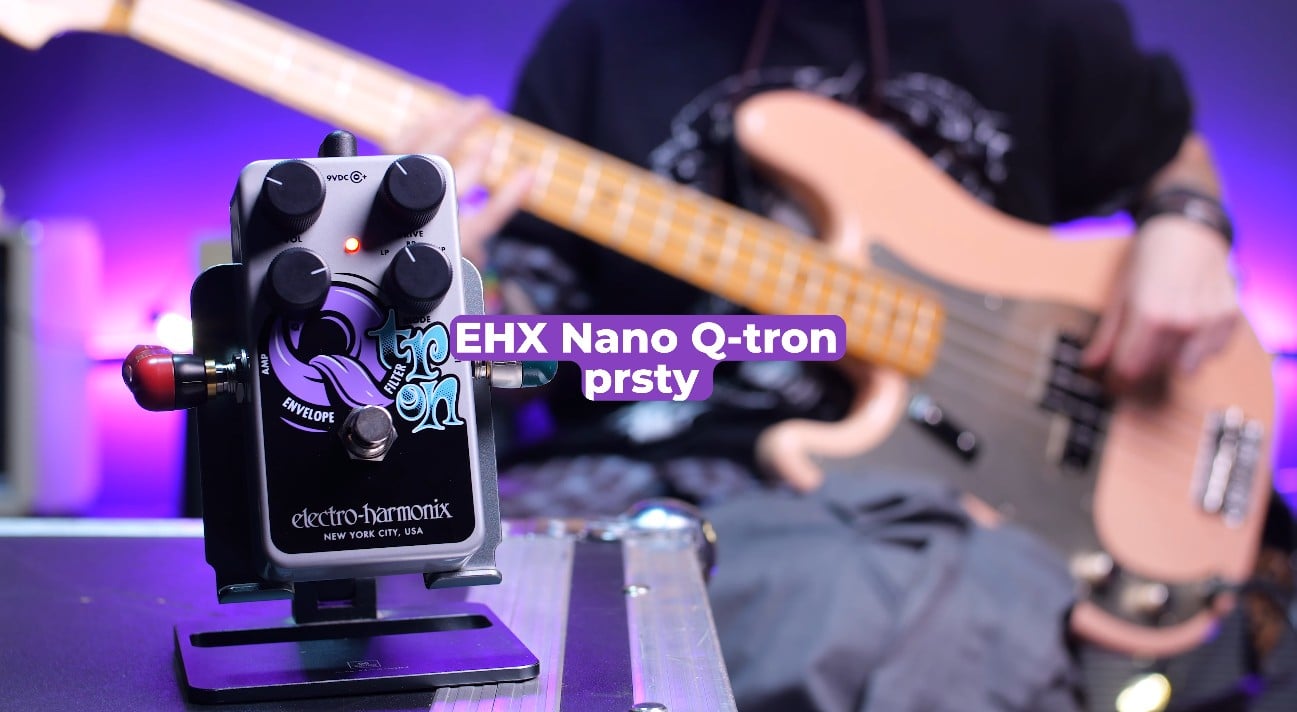
The first thing is a separate volume or output. The filter can throw your level up as well as down, and on stage that becomes a problem within one bar. When it jumps up, you drown out the whole band. When it drops, the bass disappears and everyone looks around wondering what is going on. That is exactly why the Electro-Harmonix Q-Tron has its volume separate.
The second thing is blend, meaning how much dry signal you mix into the wet one. The filter often takes the low end away from the bass and blend gives it back, the way the Dunlop MXR M82 does. The third thing is the number of modes and the filter direction. The more options you get, the longer you spend hunting your sound, but the wider the range you end up with. The fourth thing is space on your board. Mini pedals like the Mooer Envelope take up half the room and cost a fraction, they are just harder to operate. You will find the full range in wah-wah for bass guitar, in bass guitar effects pedals and in bass multi-effects.
The sound test
Matej played the pedals one after another in the order they sat on the board, all on the same bass. The samples were played by Laura Jašková, who is not that into this type of effect herself, so in the video you get a second opinion as well.
It opens with the Boss AW-3 Dynamic Wah. Matej calls it an unbreakable box you could rely on even after a nuclear war, and Laura takes it as the industry standard that adds the effect without spoiling your tone. Second comes the Electro-Harmonix Q-Tron. Third are the mini pedals from MOOER at around sixty euros, which handle a surprising number of modes for their size, only the frequencies jump around at times. Fourth is the Aguilar Filter Twin, the heavyweight from a maker bass players know from bass amp heads and combos. Fifth is the EMMA Electronic DiscumBOBulator V3, Matej own pedal brought from home. Sixth is the Dunlop MXR M82 Bass Envelope Filter, which according to Matej turns up on every bass player board sooner or later. Seventh is the Mooer Envelope, and the test closes with the Electro-Harmonix Bassballs, which Matej believes is also played by Flea.
The winner and the best value for money
The test was won by the Electro-Harmonix Q-Tron. It has a juicy wah and does exactly what it should. The main argument, though, is that separate volume. With these effects the levels jump up and down, and as a bass player you cannot afford that on stage. Laura adds that the Q-Tron is beautifully designed too and she would buy it even without hearing it play.
Matej long-time favourite is the EMMA DiscumBOBulator V3, which he brought from home for the shoot. He owns the third version of this effect as his personal pedal, and out of the dozens of envelope followers that have passed through his hands it is still the best one he has owned. It does not have many pots, so you get a good sound out of it quickly on bass as well as guitar, it adds a built-in boost for solos and it has a side chain input where you send a kick drum and it triggers the effect for you.
The Aguilar Filter Twin is the only one in the test with two parallel filters. One sweeps up, the other down, and you blend smoothly between them, something Matej has not seen on any other filter. The Boss AW-3 is the safe bet you plug in and play, just like everything from Boss. The mini MOOERs at around sixty euros are the best value for students, they are just a bit untamed and their glitching made Laura laugh during testing. The Mooer Envelope surprised Matej with a juicy sound straight from the floor and he would put it on his shortlist for a new piece, it is only harder to operate on that small footprint. The Dunlop MXR M82 mixes in the dry signal, but sounds more sterile, more tinny and more mid-focused, so it inspires less. And the Bassballs has one knob, so it sounds basically the same at any setting, plus a distortion to fatten it up. If that sound works for you, you buy it on the spot. If not, there is nowhere further to go.

Frequently asked questions about envelope followers
What is an envelope follower?
A filter that opens and closes according to how hard you play. It tracks the envelope of the signal and moves a frequency filter accordingly. It is also called an envelope filter or auto-wah. On bass guitar it creates that typical quacking sound.
What is the difference between an envelope follower and a wah pedal?
The filter is basically the same, the control is what differs. You work a wah-wah pedal with your foot, while an envelope follower reacts to the attack of your right hand. The wah gives you precise control over the sweep, the envelope follower frees up your foot and lands exactly on the note. You will find both types in wah-wah for bass guitar.
Why does the bass in Sir Psycho Sexy sound like a duck?
Behind that sound is an envelope filter. The filter sweeps through the mid frequencies very fast and the ear reads that sweep as the syllable "wah". You hear the same principle in Chameleon by Herbie Hancock and in Higher Ground by Stevie Wonder.
Which envelope follower should you choose for bass guitar?
Look for a model with a separate volume and a blend for the dry signal, so the filter does not eat your low end. Safe choices are the Electro-Harmonix Q-Tron, the EMMA DiscumBOBulator V3 or the Dunlop MXR M82. If price and board space matter, have a look at the Mooer Envelope. The full range is in bass guitar effects pedals.
Who invented the envelope follower?
Engineer Mike Beigel in the seventies. He pulled the circuit out of his own experimental synthesizer that never reached production and founded a company called Musitronics. The shortened name Mu-tron became a brand every bass player knows.
Do I need anything else besides the envelope follower?
A bass guitar, the pedal and an amp will do. If you want the filter to sound on stage the way it does in the rehearsal room, add a bass combo with an effects loop and a pedalboard that keeps the pedal from sliding around.
Pick your envelope follower
A bass that sounds like a duck comes down to one box and your right hand. The first episode of StompStory is also the first of a whole series, so go through the wah-wah pedals, wah-wah for bass guitar, all the guitar effects or the bass guitar effects pedals. If you are working out how to order them on the board, our pedalboard guide will help. And if you have not watched the second StompStory episode on the history of fuzz or the third one on chorus, put those on too.