 Albania
 Argentina
 Australia
 Austria
 Belgium
 Bosnia and Herzegovina
 Brazil
 Bulgaria
 Canada
 Chile
Chile
 Colombia
 Croatia
 Czech Republic
 Denmark
 Estonia
 Finland
 France
 Germany
 Greece
 Hungary
 Ireland
 Italy
Italy
 Latvia
 Lithuania
 Luxembourg
 Mexico
 Moldova
 Montenegro
 Netherlands
 New Zealand
 North Macedonia
 Norway
 Philippines
 Poland
 Portugal
 Romania
 Serbia
 Slovakia
 Slovenia
 South Africa
 Spain
Spain
 Sweden
 Switzerland
 Turkey
 Ukraine
 United Kingdom
 United States of America



History of fuzz effects for bass guitar
Did you know that one of the most iconic effects in history was born from a broken tube and at first barely sold at all? Fuzz appeared by accident in 1961 and gradually changed the sound of the bass, of rock and of a whole generation. See its story from the Maestro FZ-1 to the Big Muff and hear a massive test of fuzzes on bass guitar from the second episode of StompStory.

Watch the whole StompStory 2 episode
You can hear the whole story of fuzz and the complete sound test in the second episode of the StompStory series with bassist Matej Krivánek. Watch the video on our YouTube and tell us in the comments which fuzz you like most. Below you will find the whole story in text as well and links to all the tested fuzz effects.
How did fuzz come about?
Fuzz appeared by accident in 1961, when during a recording in Nashville a tube in the mixing desk failed and the bass suddenly sounded distorted and beautiful.
They were recording the country song Don’t Worry by Marty Robbins and the bass solo was played by Grady Martin on a Fender Bass VI. A tube in the desk preamp cracked and instead of a clean bass a rough, mid-heavy distortion came out. The bassist wanted a new take, but producer Glenn Snoddy liked the sound so much that he kept it on the record. The song became a huge hit and the world heard fuzz for the first time.
The first fuzz pedal in the world
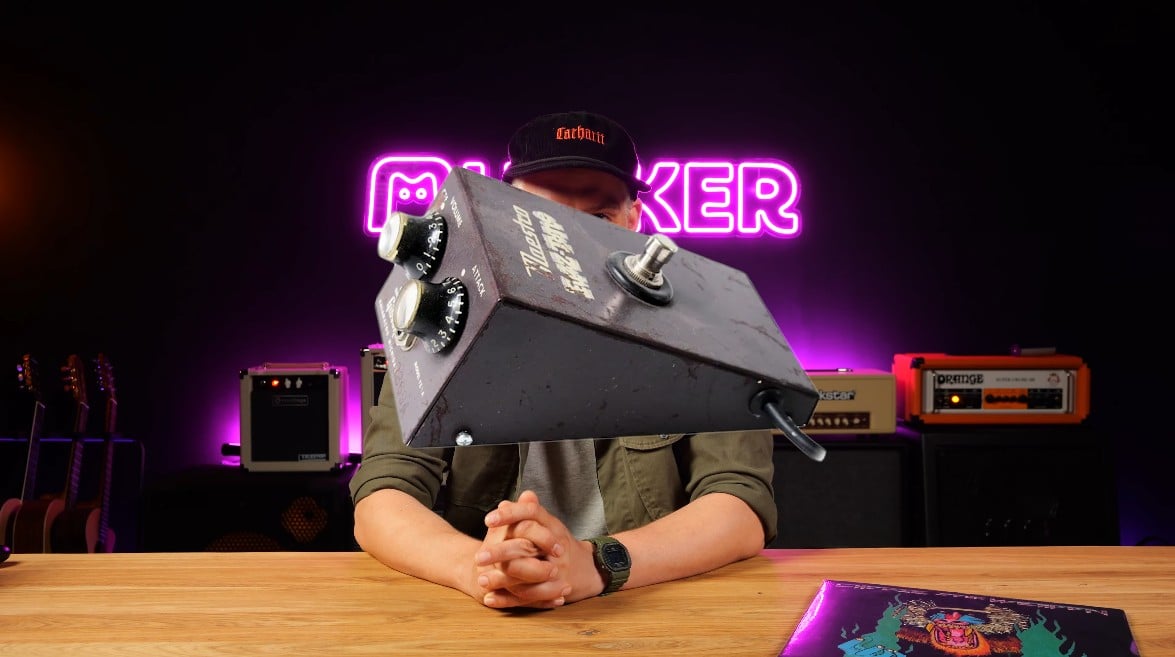
The first fuzz pedal was the Maestro FZ-1 Fuzz Tone by Gibson from 1962, the very first effect that lay on the floor and was controlled by foot.
Glenn Snoddy built a transistor circuit that simulated the tube fault and sold the patent to Gibson. It made 5,000 units and expected a bombshell. But marketing sold the pedal as a brass-section simulator and the result was tragic. In 1963 four units sold worldwide and in 1964 zero. Gibson even built the leftover circuit straight into the bass guitar EB-0F, yet only 211 of those sold and today it is a rarity worth thousands of euros.
The turning point came in 1965
Everything changed in May 1965. Keith Richards of the Rolling Stones found a Maestro fuzz left in the studio and only wanted to sketch a part for a brass section with it. Instead the riff of Satisfaction was born, the one the whole world knows. Keith did not like the sound of the fuzz, but the band overruled him and they never called the brass players. The song exploded, Gibson sold out its stock within a month and launched the FZ-1A version, of which over 31,000 units sold.
How fuzz became the voice of a generation
The new sound opened doors for a generation that wanted to set itself apart. In eight years music moved from the smooth Marty Robbins to Jimi Hendrix, who at Woodstock played the American anthem on a distorted Stratocaster amid mud and an anti-war mood. Fuzz was no longer just an effect, but the voice of the era.
What is the Big Muff and why do bassists love it?
The Big Muff is a fuzz by Electro-Harmonix from the 1970s that added massive lows and endless sustain, and that is exactly why it became a favourite of bassists.
The founder of Electro-Harmonix, Mike Matthews, wanted a pedal for endless sustain without maxing out amps. The first was the Triangle Muff, and even Carlos Santana showed interest. Then came the Ram’s Head with fewer mids, which David Gilmour of Pink Floyd took to on the albums Animals and The Wall. In the late 1970s it got the iconic red-black design with the Greek letter Pi and briefly an op-amp circuit with a more aggressive sound, which Billy Corgan loved on Siamese Dream. In the 1980s Matthews moved production to Russia under the Sovtek brand, where the Russian Muffs with huge bass were born. And in the 1990s the Big Muff stood at the center of the grunge wave, when Mudhoney released the album Superfuzz Bigmuff and Kurt Cobain of Nirvana used it on Nevermind. You will find the whole family among the fuzz effects.

A massive test of fuzzes on bass guitar
Matej Krivánek recorded the fuzzes chronologically, decade by decade, so you can hear how the sound of the bass gradually changed. The differences are bigger than you would expect.
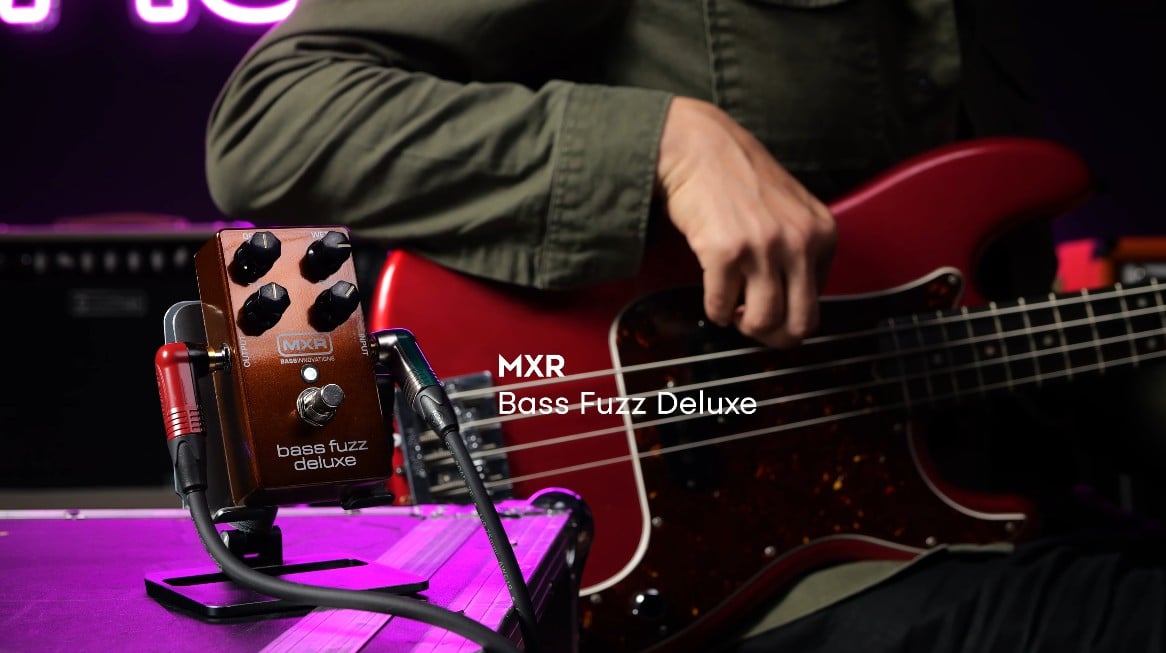
From the Big Muff series by Electro-Harmonix you hear the Triangle Big Muff Pi, J Mascis Ram’s Head Big Muff Pi, Ram’s Head Big Muff Pi, Big Muff Pi 2, the aggressive Op-Amp Big Muff Pi, the Russian Green Russian Big Muff, Nano Bass Big Muff and Big Muff USA. The modern era is represented by the Darkglass Duality Fuzz and the Dunlop MXR M84 Bass Fuzz Deluxe. Each sounds different, from fat mids to a saw that cuts.
Frequently asked questions about fuzz
How did the fuzz effect come about on guitar?
By accident. In 1961, during the recording of the song Don’t Worry by Marty Robbins, a tube in the mixing desk preamp failed and the bass suddenly sounded distorted and beautiful. The producer kept that sound on the record and so fuzz was born.
What was the first fuzz pedal?
The Maestro FZ-1 Fuzz Tone by Gibson from 1962, the very first effect pedal controlled by foot. It was really made famous only by the Satisfaction riff by the Rolling Stones. You will find the full range among the fuzz effects.
Which fuzz to choose for bass guitar?
For bass look for a fuzz with a blend knob that keeps the low end, for example the Nano Bass Big Muff, the Dunlop MXR M84 Bass Fuzz Deluxe or the Darkglass Duality Fuzz.
Which musicians made fuzz famous?
Keith Richards recorded Satisfaction with it, Jimi Hendrix played it at Woodstock, David Gilmour of Pink Floyd on Animals and The Wall, Billy Corgan on Siamese Dream and Kurt Cobain of Nirvana on Nevermind. Fuzz stands at most of the turning points of rock.
Is fuzz the same as distortion or overdrive?
No. Fuzz is the oldest and most extreme distortion, which clips the wave almost into a square and sounds rough. Overdrive is gentle and distortion sits somewhere in between. The differences are covered in the article how to choose a guitar effect.
Choose your fuzz
Fuzz is an effect with perhaps the biggest story in history. Have a look at the fuzz effects by Electro-Harmonix and Darkglass, or the whole bass guitar effects and guitar effects range. And if you have not watched the whole StompStory 2 episode yet, play it, you can hear all the fuzzes live there.