 Albania
 Argentina
 Australia
 Austria
 Belgium
 Bosnia and Herzegovina
 Brazil
 Bulgaria
 Canada
 Chile
Chile
 Colombia
 Croatia
 Czech Republic
 Denmark
 Estonia
 Finland
 France
 Germany
 Greece
 Hungary
 Ireland
 Italy
Italy
 Latvia
 Lithuania
 Luxembourg
 Mexico
 Moldova
 Montenegro
 Netherlands
 New Zealand
 North Macedonia
 Norway
 Philippines
 Poland
 Portugal
 Romania
 Serbia
 Slovakia
 Slovenia
 South Africa
 Spain
Spain
 Sweden
 Switzerland
 Turkey
 Ukraine
 United Kingdom
 United States of America



×
Translation missing. Options considered were:
- en.public.user_set_items.show.unsaleable
- en.public.user_set_items.unsaleable
Chorus: the effect that defined the 80s
Did you know the first chorus in the world rang out in a church four hundred years before the first pedal? The chorus effect dominated the music of the 80s so strongly that it became the signature of the whole decade. Its story runs from pipe organs through a tape trick at Abbey Road to the blue box on the pedalboards of Prince and The Cure.
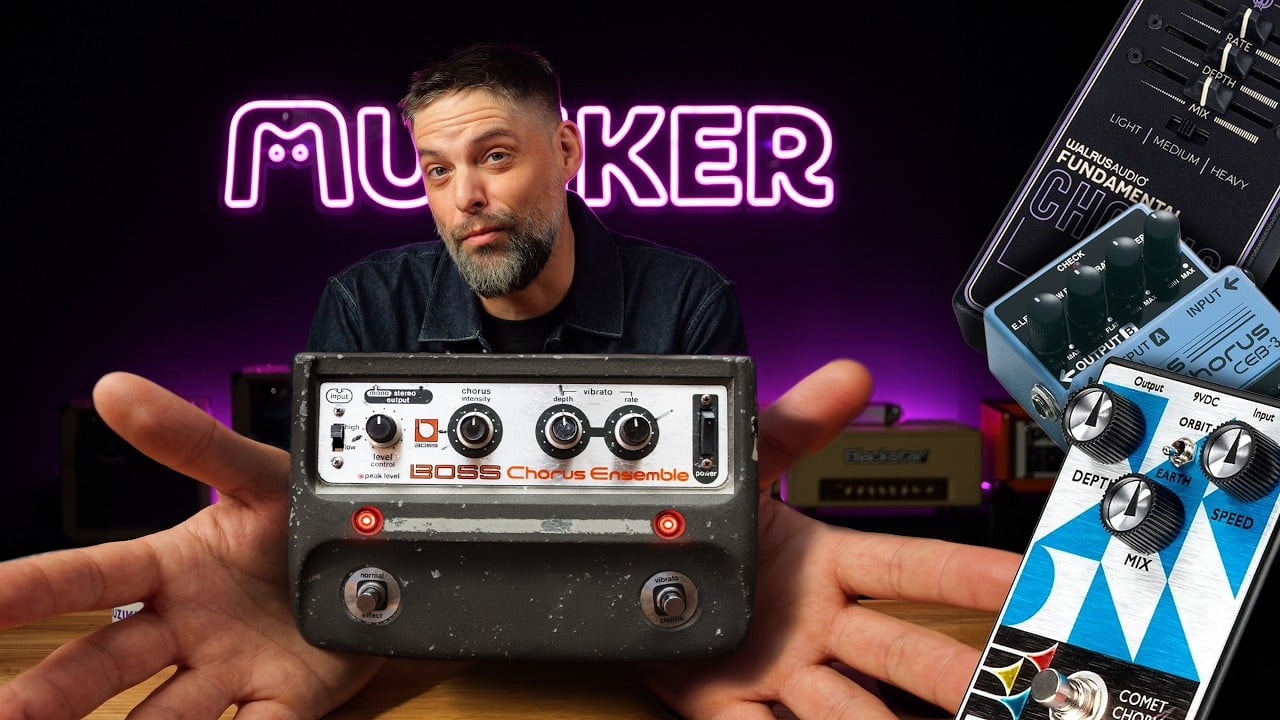
Watch the full StompStory 3 episode
You can hear the whole story of chorus and the complete sound test in the third episode of StompStory with bass player Matej Krivanek. Watch the video on our YouTube and tell us in the comments which chorus you like most. Below you will find the whole story in text, plus links to every chorus pedal we tested.
What is a chorus effect and how does it work?
A chorus effect adds a copy of your signal, shifted in time by a few milliseconds, and detunes that copy slightly. Your guitar or bass gains depth and width, as if two people were playing it at once.
Flanger, chorus, reverb and delay belong to one technical family and their architecture is basically identical. All of them work with a copy of the signal shifted in time. The only difference is the combination of three parameters. First is the delay time, which sets how long it takes for the copy to sound. Second is modulation, or LFO, which decides whether and how fast that time changes dynamically. Third is feedback, meaning how much of the effected signal goes back to the input. Chorus uses a short delay and little feedback. For how the individual effect types differ in practice, read how to choose a guitar effect.
Where does the word chorus come from?
From the English word choir. And that name describes exactly what the effect does to your sound.
When a whole choir sings or a string orchestra plays the same note, nobody hits an entirely identical frequency at exactly the same moment. Those deviations in intonation and timing are measured in milliseconds. They blend in the room and create the depth and width you hear. Chorus simulates exactly this phenomenon electronically.
Did Jesus invent the first chorus?
The first technology that simulated this phenomenon was used in church organs from the first half of the 16th century. A second pipe was added to the base note, detuned a few cents higher. Played together, the two notes merged into one that sounds fuller and more spacious. So yes, the first chorus in the world rang out in a church, four hundred years before the first pedal.
How The Beatles built the first electronic chorus at Abbey Road
The first electronic chorus was built by sound engineer Ken Townsend at Abbey Road. Not because he wanted a new effect. He just wanted John Lennon to stop suffering.
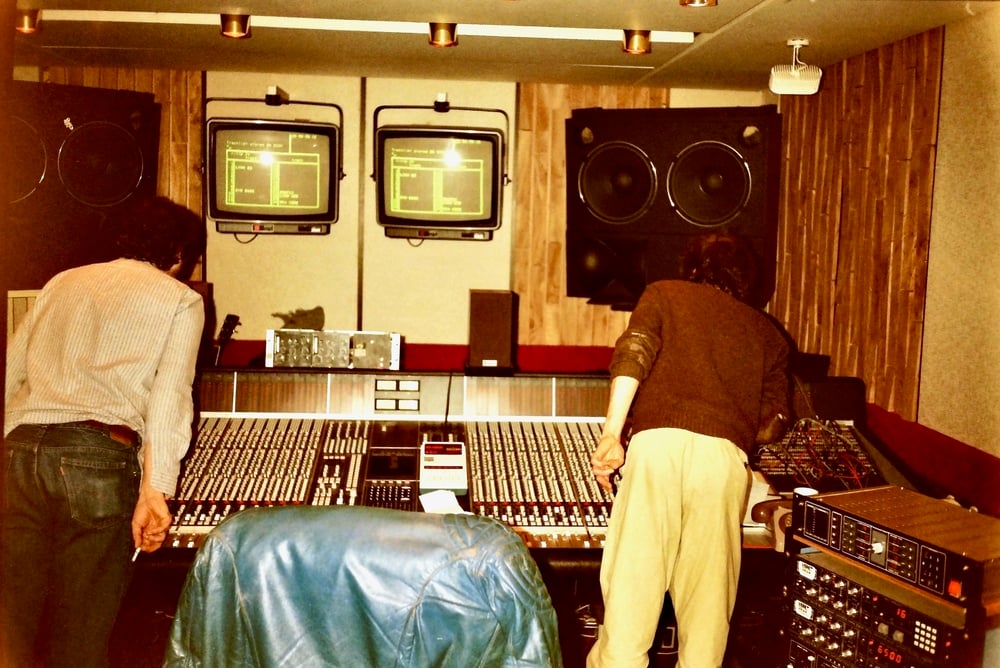
While The Beatles were recording at Abbey Road, Lennon had to track doubled vocals over and over. Townsend wanted to spare him that, so he came up with the ADT system, artificial double tracking, sometimes also called automatic double tracking. It ran on tape delay. When mixing, he sent the vocal from one tape machine into another and used an oscillator to vary the speed slightly. He then blended that altered signal with the original vocal. The first chorus was born and Lennon did not have to sing a single note again. The Beatles loved the technique and used it heavily on the breakthrough album Revolver from 1966, then on almost every album after that except Let It Be. It worked on all sorts of things: the guitar solo in Taxman and the reverse guitar in I'm Only Sleeping.
How John Lennon invented the word flanger
The word flanger is still used across the guitar world. It exists because producer George Martin made up nonsense to get Lennon off his back.
Out of curiosity Lennon asked Martin how that automatic vocal doubling actually worked. Martin told him it was far too complicated and that he would not understand it. Lennon would not let it go, so Martin invented a technical sounding answer. It was complete nonsense, but it worked. From then on, whenever Lennon wanted to use the trick, he asked for Ken's flanger. Only years later did George Martin find out that the term flanging had existed in the music world for ages and meant something else. It was a technique with two synchronised tape machines playing the same sound onto a third. The engineer would then manually use a finger to slow one tape against the other, creating that familiar whooshing sound.
The BBD chip: the discovery without which chorus would never fit in a pedal
For chorus to move from tape machines into a box on the floor, the world needed one crucial discovery. It arrived in 1969, when engineers Frans Sangster and Kees Teer at Philips introduced the BBD integrated circuit, the Bucket Brigade Device. It is an analogue circuit that creates a time delay by shifting electric charge through a series of capacitors and transistor switches. The name comes from a chain of people passing buckets of water to put out a fire. Philips later sold the patent for this chip to Roland. And that is where the modern history of chorus pedals begins.
Roland JC-120 Jazz Chorus: the chorus that mixes in the air
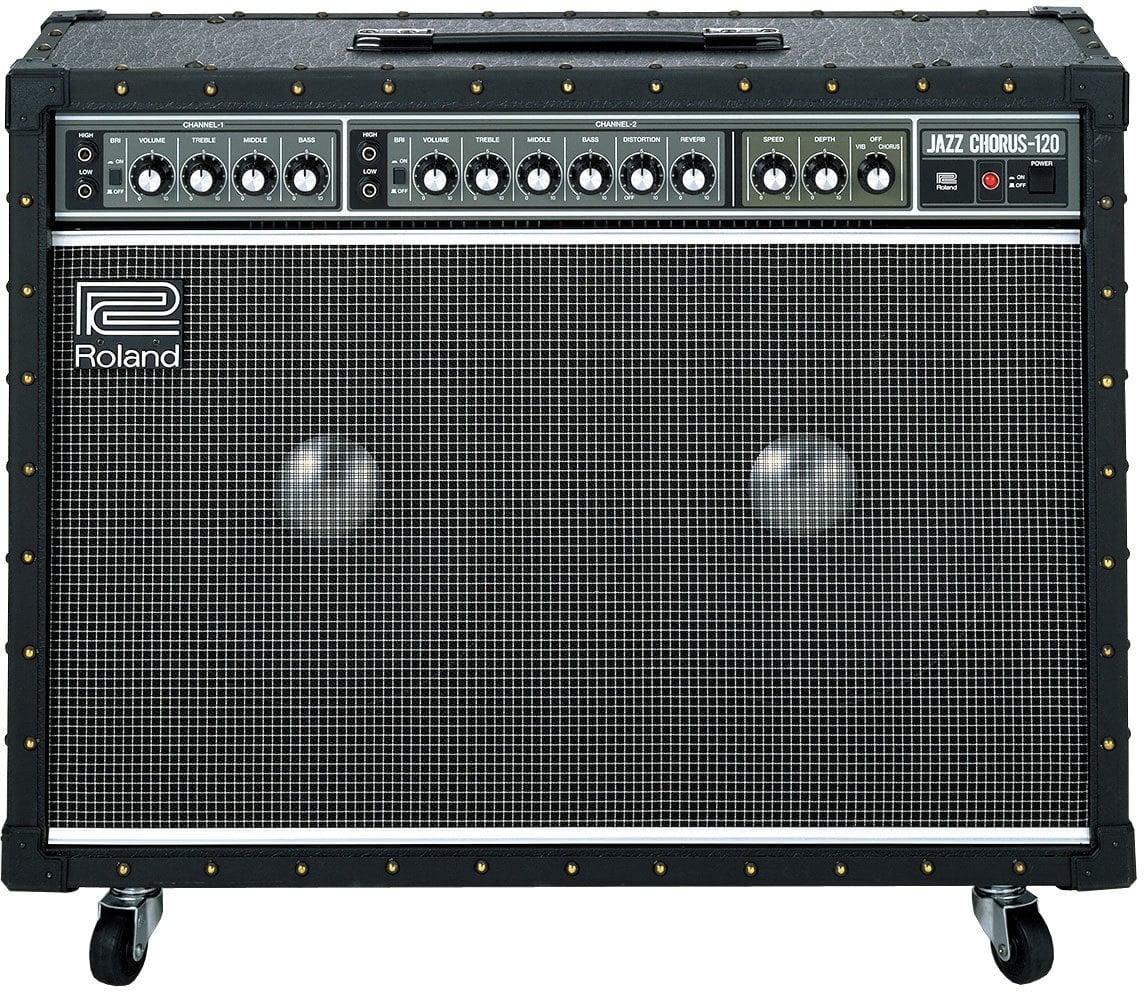
The first legendary chorus was not a pedal. It was built into a guitar combo. In 1975 Roland released the JC-120 Jazz Chorus and the guitar world changed for good.
The engineers did not mix the clean and effected sound electrically inside the circuit. They used a physical trick. The right speaker played the completely clean, dry signal from the guitar. The left one played the signal delayed by the BBD chip and modulated by an LFO oscillator. The sound only mixed acoustically, in the air in front of the combo. That created a deep, three-dimensional space nobody had heard before. One last detail: the prototype of this combo was built for Joni Mitchell, who was writing material for the album Hejira at the time. And playing with her back then was Jaco Pastorius.
Boss CE-1 and the blue CE-2: why every chorus pedal is blue
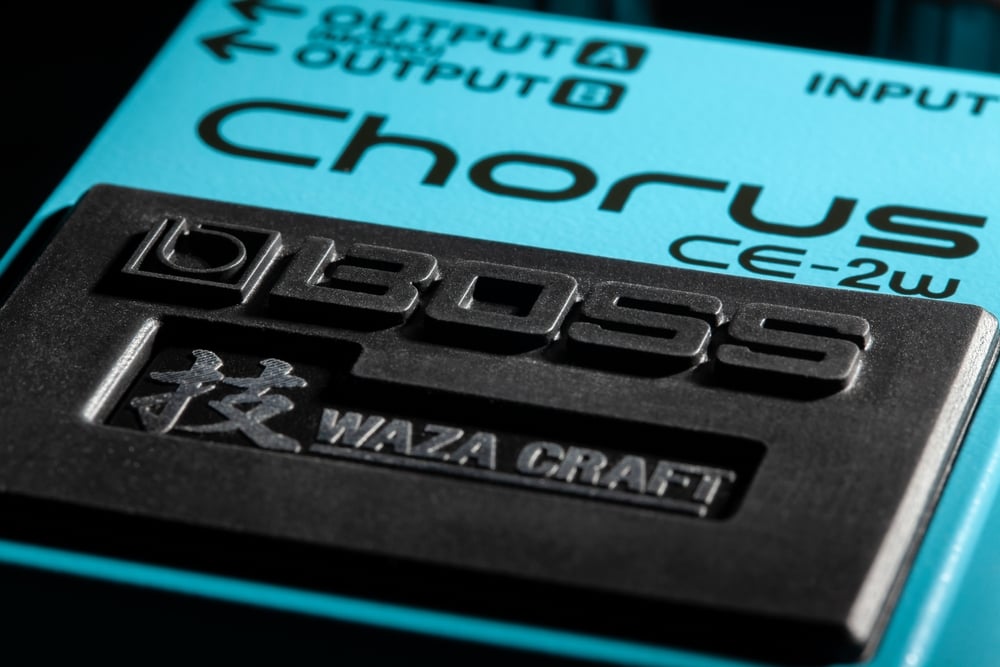
Every chorus pedal is blue because of one box from 1979. It is called Boss CE-2 and it was the first compact chorus pedal in the world.
Guitarists loved the sound of the JC-120, but they wanted that chorus with other amps too. So in 1976 Roland founded the subsidiary brand Boss, and its very first product was the CE-1 Chorus Ensemble pedal. Essentially the circuit taken out of the combo and built into a rugged metal chassis powered straight from the wall. In 1979 came the blue CE-2, which was mono, ran on a 9V battery and became a fixture on pedalboards worldwide. Its blue colour defined the visual style of the whole category, and today nearly every maker has a blue chorus in its range. The Police, The Smiths, The Cure, Prince. That is just a fraction of those this blue box shaped.
Sound test: ten chorus pedals in chronological order
Matej Krivanek recorded the choruses chronologically, decade by decade, so you can hear how the sound evolved. The differences between analogue and modern models are bigger than you would expect.
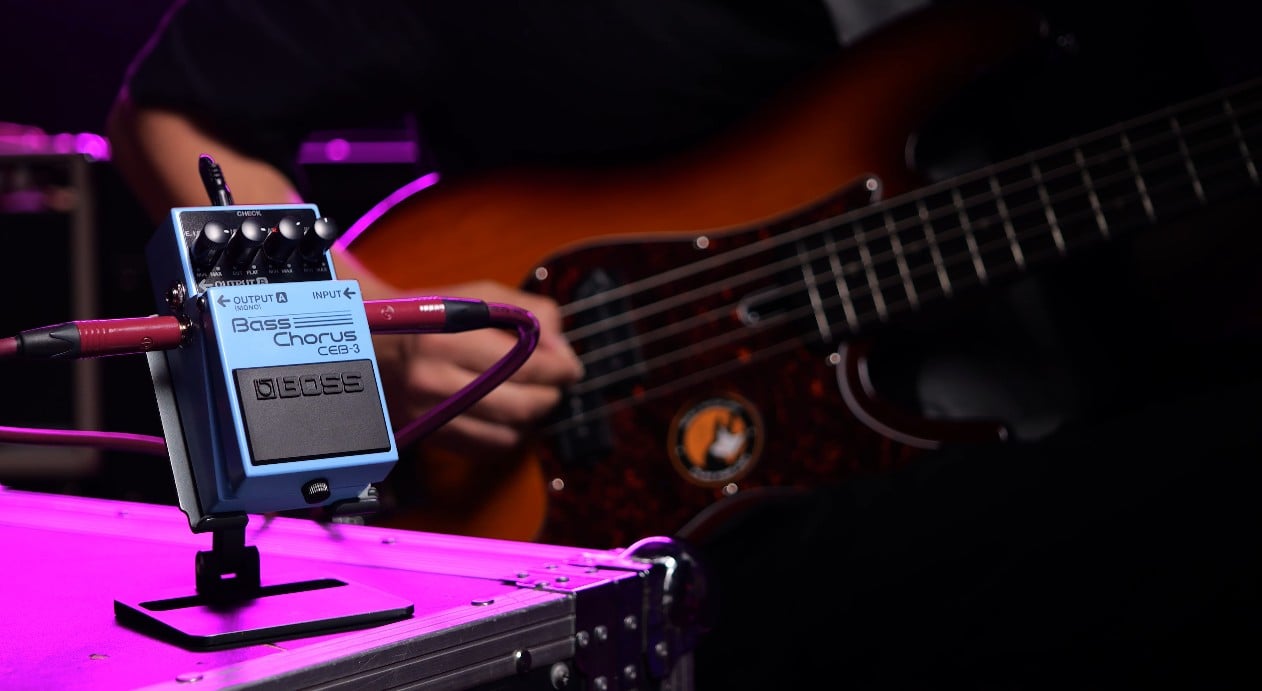
In the video you hear the Warm Audio WA-C1, Death By Audio Space Bender, the classic Boss CE-5 Chorus Ensemble, Aguilar Chorusaurus V2, TC Electronic SCF Gold SE, Boss CEB-3 Bass Chorus, Maestro Comet Chorus, Lichtlaerm Audio Nostalgia, Dunlop MXR M83 Bass Chorus Deluxe and Walrus Audio Fundamental Chorus. If you are after a historic classic, check out the Electro Harmonix Small Clone as well.
Frequently asked questions about chorus
Who invented the chorus effect?
Sound engineer Ken Townsend at Abbey Road. In 1966 he built the ADT system, artificial double tracking, so that John Lennon would not have to record the same vocals over and over. The Beatles used it on the album Revolver. The first acoustic version of chorus, however, was already known to organ builders in the 16th century.
What is the difference between chorus and flanger?
The architecture is almost identical, both work with a copy of the signal shifted in time. They differ in the combination of delay time, modulation and feedback. Chorus has a shorter delay and less feedback, so it sounds soft and spacious. Flanger has more feedback and sounds like a jet whooshing past. You will find the whole category in chorus, flanger and phaser effects.
Why are chorus pedals almost always blue?
Because of the Boss CE-2 from 1979. It was the first compact chorus pedal in the world and its blue colour became the standard that nearly every manufacturer still copies. You can get a blue chorus from us too, for example the Boss CE-5.
Which chorus should you choose for bass?
For bass look for a chorus with a blend knob that keeps your low end. Safe bets are the Boss CEB-3 Bass Chorus, Dunlop MXR M83 Bass Chorus Deluxe or Aguilar Chorusaurus V2. The full range is in bass effect pedals.
Which musicians made chorus famous?
The Police built their entire guitar sound on chorus, The Cure used it to define the mood of their albums, The Smiths had it in their jangly guitar tone and Prince used it on guitar and keys alike. Joni Mitchell received a JC-120 prototype before the amp was even launched.
Pick your chorus
Chorus is the effect that turned one box into the sound of an entire decade. Have a look at chorus, flanger and phaser pedals, all guitar effects or bass effects. If you are working out how to order them on your board, the pedalboard guide will help. And if you missed StompStory 2 on the history of fuzz, give that a watch too.