Albania
 Argentina
 Australia
 Austria
 Belgium
 Bosnia and Herzegovina
 Brazil
 Bulgaria
 Canada
 Chile
 Colombia
 Croatia
 Czech Republic
 Denmark
 Estonia
 Finland
 France
 Germany
 Greece
 Hungary
 Ireland
 Italy
 Latvia
 Lithuania
 Luxembourg
 Mexico
 Moldova
 Montenegro
 Netherlands
 New Zealand
 North Macedonia
 Norway
 Philippines
 Poland
 Portugal
 Romania
 Serbia
 Slovakia
 Slovenia
 South Africa
 Spain
 Sweden
 Switzerland
 Turkey
 Ukraine
 United Kingdom
 United States of America



Speaker PA Sets
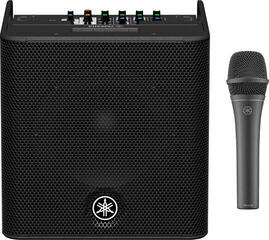
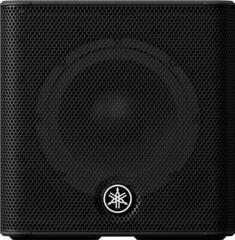
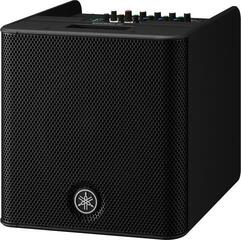
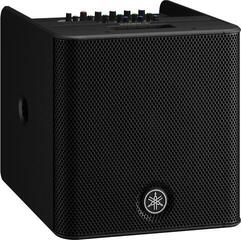
A PA system combines loudspeakers and the required signal processing into a system for speech, music or live performance. It may be a compact column system for one performer, a pair of active loudspeakers with a mixer, or a setup with a subwoofer and stage monitors. The right configuration depends on the sources, venue, audience, required coverage and transport options. Start with a simple drawing of the entire signal chain; a power rating alone will not design a system.
First, consider how the event will run
Speech in a small room mainly needs clarity, good loudspeaker placement and enough microphone inputs. A singer with a guitar also needs monitoring and an instrument input. A band adds drums, more microphones, separate monitor mixes and often bass support. A DJ needs suitable line inputs, reliable playback and coverage of the dance floor.
Room size alone is not enough. The floor plan, height, surfaces, ambient noise and whether people are seated or standing all matter. An outdoor event has no support from walls, and the equipment must be suitable for the conditions. For a larger or irregular space, it is advisable to have a technician design the system, taking delay zones, suspension safety and power supply into account.
| Configuration | When it makes sense | Benefit | What to allow for |
|---|---|---|---|
| Compact or column system | Solo, duo, presentation, smaller production | Fast setup and few separate parts | Limited expansion and number of inputs depending on the model |
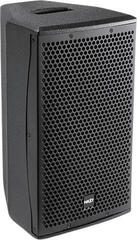
| Two active loudspeakers and a mixer | Band, DJ, versatile events | Simple stereo or even left/right coverage | Power at each speaker and separate cabling |
| Passive loudspeakers with an amplifier | Fixed installation or purpose-designed system | Centralised amplification and freedom to choose components | Correct matching of impedance, power and cables |
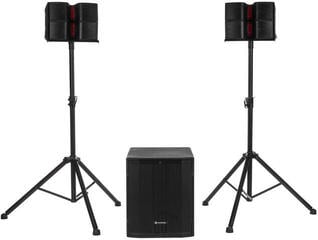
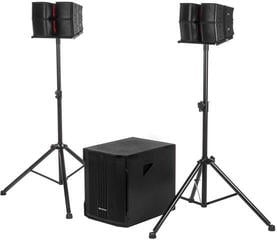
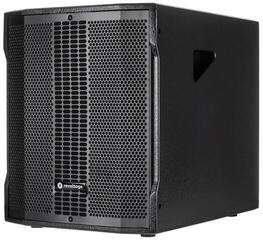
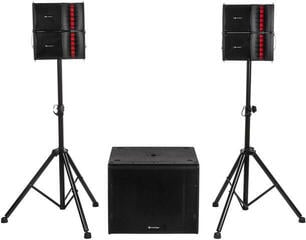
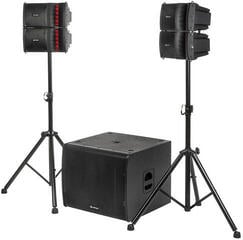
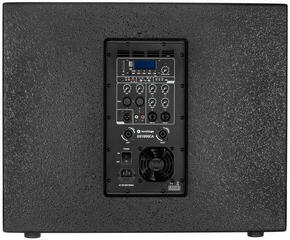
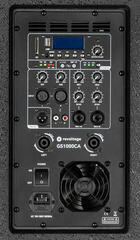
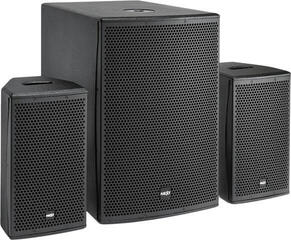
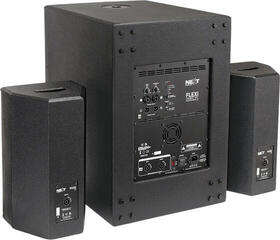
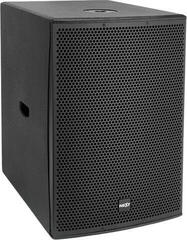
| System with a subwoofer | Music with pronounced bass, drums, electronic production | Relieves the main loudspeakers in the low-frequency range | Crossover frequency, polarity, placement and additional transport |
Active and passive signal paths
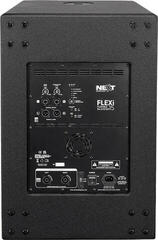
Active loudspeakers have the amplifier built in. You connect them to the mixer with a signal cable, and each speaker needs power. The system is easy to expand one unit at a time and often includes basic signal processing. However, keep track of the number of power connections, safe cable routing and options for linking another speaker.
Passive loudspeakers require a suitable power amplifier and speaker cables. The amplification can remain in one rack, which suits some fixed or larger systems. The design must respect impedance, channel wiring and permitted load. An XLR signal cable and a speaker cable with a similar connector are not interchangeable.
The mixer is the control centre
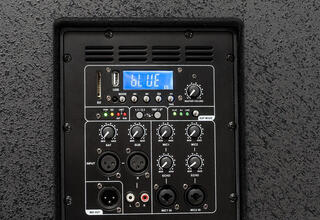
Count channels according to the real sources and leave spare capacity for a presenter, guest or playback device. Microphone inputs, line inputs and instrument sources do not have the same requirements. A mixing console may provide phantom power, EQ, effects and auxiliary outputs for monitors. During the programme, finding the control you need quickly is more valuable than having functions you cannot reach.
A digital mixer stores scenes and offers extensive routing, while an analogue mixer shows most controls directly on the panel. When deciding, consider the operator's experience, the number of monitor mixes and time for the soundcheck. USB recording or network control is useful only when it is compatible with your workflow.
A subwoofer is not essential for every event
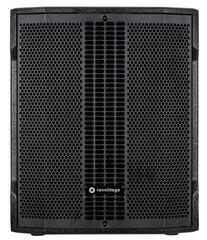
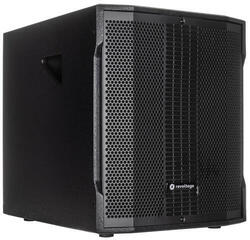
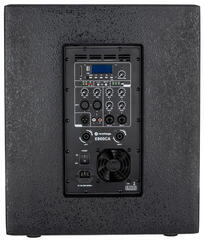
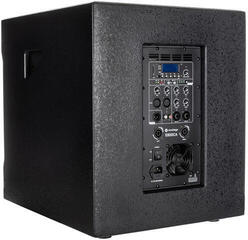
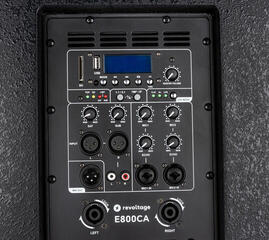
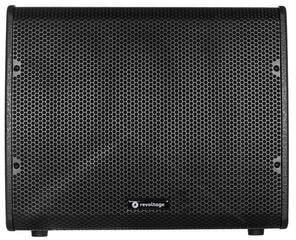
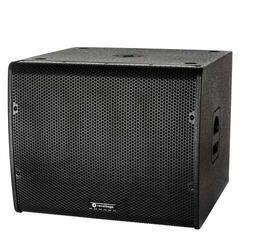
For speech alone, a subwoofer may be unnecessary, and poorly adjusted bass is more likely to impair intelligibility. For a band, DJ production or playback of a full music programme, an active subwoofer can take over the low frequencies. Check how it sends signal to the main loudspeakers, which filter the system uses and where polarity or delay is set.
Even moving a subwoofer a short distance can significantly change the bass in a room. Two units placed without a plan may add bass in some places and remove it in others. Start with the manufacturer's recommended wiring, keep the system symmetrical where appropriate, and assess the settings at several audience positions.
Monitoring for performers
The main loudspeakers face the audience, but musicians need to hear themselves and the others. An active stage monitor has its own amplifier and receives a separate auxiliary mix. More monitor mixes allow different balances for the singer, drummer or keyboard player. Each additional mix, however, needs a mixer output, cables and time to set up.
Place the monitor in the least sensitive area of the microphone according to its polar pattern, and raise the volume carefully. This reduces the risk of feedback. An alternative is wireless in-ear monitoring, which limits stage volume but requires a correct personal mix, a safe level and frequency coordination.
Microphones and wireless sources
A wired microphone is predictable and needs neither a battery nor a radio frequency. A wireless set gives the presenter or singer freedom of movement, but adds a receiver, power supply and frequency management. With multiple systems, it is not enough to choose randomly different channels; their compatibility must be planned. Spare batteries and a wired microphone are practical backup.
You can connect instruments with an unbalanced output to the mixer via a DI box. The long balanced run then resists interference better, and the through output can continue to an amplifier. With a laptop or stereo player, allow for two channels if you want to preserve stereo.
Signal flow and level setting
- Connect sources with the outputs turned down, and label both channels and cables.
- Set input gain one at a time at the loudest expected level; leave headroom.
- Engage the high-pass filter where you do not need deep frequencies, and use EQ sparingly.
- Create monitor mixes at a low level. Only then fine-tune the main mix for the audience.
- Walk through the entire space and check intelligibility, coverage and areas prone to feedback.
Transport, stands and safety
Raise the main loudspeakers above the audience's heads on stands with suitable load capacity and mounting dimensions. Fully spread the legs, do not load them with cables, and place them outside walkways. Choose suitable loudspeaker stands according to weight and mounting point. Suspending equipment above people is work for a qualified person and components designed for suspension.
Count cases, power distribution, extension leads, signal runs and adapters. A heavy system that does not fit in the vehicle or cannot be set up safely is not a practical choice. Before the event, connect the system in the rehearsal room, label both ends of every cable and prepare a simple build-order plan.
Checking the complete system
- sources and number of inputs, including a backup microphone or playback device;
- main loudspeakers, any subwoofer and all power points;
- number of separate monitor mixes and mixer outputs;
- stands, safety solutions, cases and transport method;
- signal and speaker cables of the correct type and length;
- time for setup, soundcheck and a person who can operate the system.
Ready-made complete sound systems can simplify the initial selection, but still compare their inputs, expansion options and accessories with the specific event. An intelligible result depends on placement, cabling and adjustment of the entire PA system, not on one isolated parameter.