 Albania
 Argentina
 Australia
 Austria
 Belgium
 Bosnia and Herzegovina
 Brazil
 Bulgaria
 Canada
 Chile
Chile
 Colombia
 Croatia
 Czech Republic
 Denmark
 Estonia
 Finland
 France
 Germany
 Greece
 Hungary
 Ireland
 Italy
Italy
 Latvia
 Lithuania
 Luxembourg
 Mexico
 Moldova
 Montenegro
 Netherlands
 New Zealand
 North Macedonia
 Norway
 Philippines
 Poland
 Portugal
 Romania
 Serbia
 Slovakia
 Slovenia
 South Africa
 Spain
Spain
 Sweden
 Switzerland
 Turkey
 Ukraine
 United Kingdom
 United States of America



How to choose a classical guitar
Most people know the classical guitar as the first one they learned on. It is also called a Spanish guitar and music schools still start on it. We go through what size a child and an adult need, and which strings you are allowed to fit.

What sets a classical guitar apart
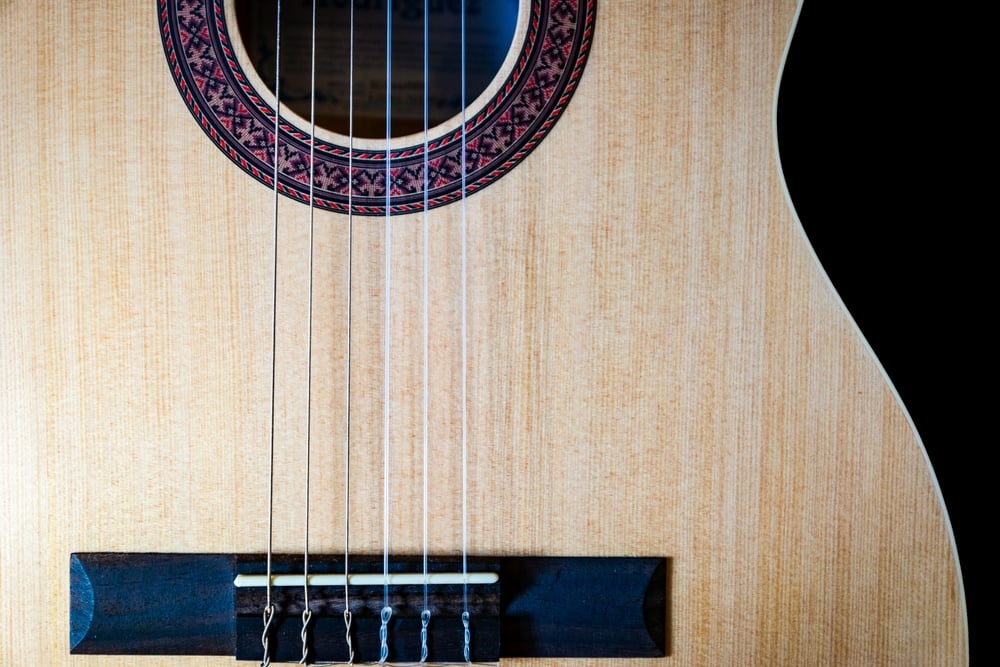
A classical guitar has nylon strings, a wider neck and a softer, rounder sound. Those three differences explain everything else. Nylon carries roughly a third of the tension of steel, so the strings press into your fingertips far less and do not tear them up in the first weeks. On the other hand barre chords are harder at first, because the neck is about 52 mm wide against 43 mm on an acoustic guitar.
That wide neck is not laziness in the design. Classical playing is built on the right hand plucking with the fingers, and every string needs space around it. That is why a classical guitar is played without a pick and why arpeggios ring more clearly on it than on a narrow neck.
If you are still deciding which type is for you, read how to choose a guitar and acoustic vs. electric guitar. And if terms like bridge or fret are new to you, start with parts of a guitar.
That wide neck is not laziness in the design. Classical playing is built on the right hand plucking with the fingers, and every string needs space around it. That is why a classical guitar is played without a pick and why arpeggios ring more clearly on it than on a narrow neck.
If you are still deciding which type is for you, read how to choose a guitar and acoustic vs. electric guitar. And if terms like bridge or fret are new to you, start with parts of a guitar.
Who a classical guitar suits
The classical guitar has a reputation as a school instrument, which is a shame, because for an adult beginner it is often the smarter choice over an acoustic. Nylon strings do not dig into your fingers, so the first weeks do not hurt and you avoid the blisters that put many people off before they learn a single chord. It plays quietly, so you can practise in a flat in the evening without worrying about the neighbours. And it needs nothing else, no amp and no cable, which makes it the cheapest way to find out whether playing grabs you.
It also suits anyone heading towards fingerstyle, Spanish and Latin American music, bossa nova or the classical repertoire. The wide neck and the finger technique are exactly what those styles need.
It suits you less if you want to sit round a campfire and strum along to singing with a pick. There you will be happier with an acoustic guitar, because it is louder and cuts through better. Models built for starting out are in classical guitars for beginners.
It also suits anyone heading towards fingerstyle, Spanish and Latin American music, bossa nova or the classical repertoire. The wide neck and the finger technique are exactly what those styles need.
It suits you less if you want to sit round a campfire and strum along to singing with a pick. There you will be happier with an acoustic guitar, because it is louder and cuts through better. Models built for starting out are in classical guitars for beginners.

What size classical guitar to choose
Classical guitars are the only ones routinely made in reduced sizes, and not only for children. What decides is body height, not age.
If you are an adult, take a 4/4 and stop thinking about it. It is the standard size that all the sheet music and tabs are written for, and the vast majority of players use it regardless of build.
There is an exception. If you have small hands or are under about 160 cm, a three-quarter guitar or a short-scale model around 630 mm may suit you better. Look at the nut width too, because the usual 52 mm is a lot for smaller hands and there are models at 48 mm that play noticeably more comfortably.
With children, size is the one decision no setup can rescue. A guitar that is too big will put a child off within two months. The test is simple: the child rests the guitar on their leg, reaches the first fret with the left hand, and the elbow must not be fully straight nor the shoulder raised. It is not true that buying bigger so it lasts pays off. It lasts, but the child stops playing. Smaller guitars also resell easily.
Models for starting out are in 1/4, 1/2, 3/4 and 4/4.
| Size | Height | Scale length | Who it is for |
|---|---|---|---|
| 1/4 | up to 115 cm | ~480 mm | children 4 – 6 |
| 1/2 | 115 – 135 cm | ~530 mm | children 6 – 9 |
| 3/4 | 135 – 150 cm | ~580 mm | children 8 – 12, petite adults |
| 4/4 | over 150 cm | ~650 mm | adults and teenagers, the standard |
If you are an adult, take a 4/4 and stop thinking about it. It is the standard size that all the sheet music and tabs are written for, and the vast majority of players use it regardless of build.
There is an exception. If you have small hands or are under about 160 cm, a three-quarter guitar or a short-scale model around 630 mm may suit you better. Look at the nut width too, because the usual 52 mm is a lot for smaller hands and there are models at 48 mm that play noticeably more comfortably.
With children, size is the one decision no setup can rescue. A guitar that is too big will put a child off within two months. The test is simple: the child rests the guitar on their leg, reaches the first fret with the left hand, and the elbow must not be fully straight nor the shoulder raised. It is not true that buying bigger so it lasts pays off. It lasts, but the child stops playing. Smaller guitars also resell easily.
Models for starting out are in 1/4, 1/2, 3/4 and 4/4.
Which brand of classical guitar to choose
In this category a pricier name does not mean a better instrument. On guitars under 200 euros what matters most is how precisely the frets are dressed and whether the instrument holds tuning, and cheaper brands manage that fine when their quality control is solid.
Pasadena is the most sensible choice for a beginner and there is a concrete reason for that. The CG161 line comes in 4/4, 3/4 and 1/2, so when a child outgrows one size you buy the same instrument a number up and never have to work out whether it will suit them again. Besides natural you will find it in black, wine red and blue, which matters to children more than you would expect.
More practical still are the complete beginner sets, where the guitar comes with a bag, a tuner, spare strings and a strap in one package. They exist in 4/4, 3/4 and 1/2 and work out cheaper than buying those items separately. If you are buying someone a first guitar as a gift, this is the simplest way to forget nothing.
Valencia is the other good route in the same price bracket. The CG160 line also covers 4/4, 3/4 and 1/2 and suits anyone who wants to try something other than Pasadena.
Yamaha sits a step up, and its student CGS line is a proven classic you will meet in music schools for years. There is CGS102A in 1/2, CGS103A in 3/4 and CGS104 in full size.
Cordoba is the step for someone who means it. The C1M has a solid top and comes in 4/4, 3/4 and 1/2, so you can even justify it for a child in their third year who is starting to outplay their instrument.
If you would rather not go brand by brand, jump straight to classical guitars for beginners, where the selection is already narrowed down.
Pasadena is the most sensible choice for a beginner and there is a concrete reason for that. The CG161 line comes in 4/4, 3/4 and 1/2, so when a child outgrows one size you buy the same instrument a number up and never have to work out whether it will suit them again. Besides natural you will find it in black, wine red and blue, which matters to children more than you would expect.
More practical still are the complete beginner sets, where the guitar comes with a bag, a tuner, spare strings and a strap in one package. They exist in 4/4, 3/4 and 1/2 and work out cheaper than buying those items separately. If you are buying someone a first guitar as a gift, this is the simplest way to forget nothing.
Valencia is the other good route in the same price bracket. The CG160 line also covers 4/4, 3/4 and 1/2 and suits anyone who wants to try something other than Pasadena.
Yamaha sits a step up, and its student CGS line is a proven classic you will meet in music schools for years. There is CGS102A in 1/2, CGS103A in 3/4 and CGS104 in full size.
Cordoba is the step for someone who means it. The C1M has a solid top and comes in 4/4, 3/4 and 1/2, so you can even justify it for a child in their third year who is starting to outplay their instrument.
If you would rather not go brand by brand, jump straight to classical guitars for beginners, where the selection is already narrowed down.

What wood the top should be
The top is the one part that fundamentally decides the sound. It is what sets the air in the body moving, and everything else is secondary.
There are two ways of making it. A laminated top is glued from three thin layers, is cheap, resists changes in humidity and sounds the same for its whole life. A solid top is a single piece of wood, costs more and reacts to dry and damp air, but it has one property laminate never gets. It opens up over time, because playing loosens the wood on a microscopic level, and after two to five years it sounds fuller than on the day you bought it.
Two woods dominate on solid tops. Spruce is lighter, brighter and louder, but needs time to open. Cedar is darker and warmer and sounds fully open from day one, though it changes less over the years. Neither is better, only different. For a child in the first years laminate is perfectly fine, while for an adult who means to keep playing a solid top is almost always worth it.
There are two ways of making it. A laminated top is glued from three thin layers, is cheap, resists changes in humidity and sounds the same for its whole life. A solid top is a single piece of wood, costs more and reacts to dry and damp air, but it has one property laminate never gets. It opens up over time, because playing loosens the wood on a microscopic level, and after two to five years it sounds fuller than on the day you bought it.
Two woods dominate on solid tops. Spruce is lighter, brighter and louder, but needs time to open. Cedar is darker and warmer and sounds fully open from day one, though it changes less over the years. Neither is better, only different. For a child in the first years laminate is perfectly fine, while for an adult who means to keep playing a solid top is almost always worth it.
Nylon strings and their tension
Nylon strings are not sold by gauge the way steel strings are, but by tension. They are labelled normal tension, high tension and sometimes low tension.
Higher tension gives a louder and more defined tone and takes a harder attack, but it also pushes back more and tires a beginner faster. Lower tension plays more easily and suits children as well as guitars with a higher action. If you are not sure, start on normal tension and move only once you can name what bothers you.
The three bass strings are wound with thin metal wire, the three trebles are clear nylon. That is why the bass strings wear out first and lose their brightness even though they look intact. There is more on choosing them in how to choose guitar strings.
Higher tension gives a louder and more defined tone and takes a harder attack, but it also pushes back more and tires a beginner faster. Lower tension plays more easily and suits children as well as guitars with a higher action. If you are not sure, start on normal tension and move only once you can name what bothers you.
The three bass strings are wound with thin metal wire, the three trebles are clear nylon. That is why the bass strings wear out first and lose their brightness even though they look intact. There is more on choosing them in how to choose guitar strings.

What you need on top for lessons
If you are an adult heading to a teacher or a course, a guitar and a tuner are enough. Nobody will ask for more, and you add the rest according to where you get to.
Music school is one step more demanding. For a school an ordinary classical guitar in the right size is fine, and the teacher will almost always only insist on nylon strings and a classic wide neck, which every model in classical guitars meets. What is worth sorting out straight away is a footstool for the left foot, because the classical sitting position raises the neck to an angle you cannot reach without one, and the teacher will want it from the first lesson. The second is a bag, since the instrument will travel twice a week.
If you are still deciding whether a guitar is the right choice for your child, musical instruments for children and choosing an instrument by the child's age will help.
Music school is one step more demanding. For a school an ordinary classical guitar in the right size is fine, and the teacher will almost always only insist on nylon strings and a classic wide neck, which every model in classical guitars meets. What is worth sorting out straight away is a footstool for the left foot, because the classical sitting position raises the neck to an angle you cannot reach without one, and the teacher will want it from the first lesson. The second is a bag, since the instrument will travel twice a week.
If you are still deciding whether a guitar is the right choice for your child, musical instruments for children and choosing an instrument by the child's age will help.
How much a decent classical guitar costs
| Budget | What you get | Typical model |
|---|---|---|
| up to €90 | laminate, child sizes, basic hardware | Pasadena CG161 |
| €90 – 200 | laminate with better finishing, more precise frets | Valencia CG160, Yamaha CGS |
| €200 – 450 | solid top, better tuners | Cordoba C1M |
| over €450 | solid wood, hand work, selected timber | advanced and concert playing |
For an adult beginner it is worth stepping into the second bracket, around 150 euros. You will hear the difference between the cheapest guitar and one of these within a week, mainly in how precisely the frets are dressed and whether the instrument holds tuning at all. With children it is the other way round, there is no point overshooting the budget, because the instrument lasts exactly as long as it takes the child to outgrow it.
What to buy alongside it
A few more things go with the guitar and none of them is expensive. We have already mentioned the footstool and the bag; add a tuner to that, because nylon strings drift far more than steel in the first days after fitting, and without a tuner you will learn to play out of tune. A stand solves the fact that a guitar leaning against a wall falls over sooner or later.
A capo comes later, and watch out, a classical guitar needs a wider model, the usual acoustic one may not fit. The rest is in guitar accessories. Once the instrument is home, how to learn to play the guitar will walk you through the first chords and you can tune it following how to tune a guitar.
A capo comes later, and watch out, a classical guitar needs a wider model, the usual acoustic one may not fit. The rest is in guitar accessories. Once the instrument is home, how to learn to play the guitar will walk you through the first chords and you can tune it following how to tune a guitar.
Frequently asked questions about classical guitars
Is a Spanish guitar the same as a classical guitar?
Yes, they are two names for the same instrument. The word Spanish is used because the modern shape of the guitar was settled in the 19th century by the Spanish luthier Antonio de Torres. In shops and music schools you will mostly meet the term classical guitar, so if you are looking for a Spanish one, look in classical guitars.
Is a classical guitar suitable for an adult beginner?
Yes, and for many people it is the best possible start. Nylon strings are far gentler on the fingers than steel, so the first weeks do not hurt and fewer people give up. The guitar plays quietly, so you can practise in a flat in the evening, and it needs no amplification. If you find you would rather strum along to singing with a pick, you can move to an acoustic guitar later, but the fingerstyle basics come with you.
Which classical guitar should you buy first?
For most people the best start is a Pasadena CG161 in the right size, or straight away as a complete beginner set with a bag, tuner and spare strings in one package. It is a laminate guitar, which is plenty for the first year, and it exists in every size, so moving up means changing only the number. If you want a class higher right away, look at the Valencia CG160 or the student Yamaha CGS line.
Can I put steel strings on a classical guitar?
No. Steel strings carry roughly three times the tension of nylon, and a classical guitar is built lighter, with thinner bracing and often without a truss rod in the neck. Steel strings will bend the neck and can pull the bridge off the top. If you want a steel sound, you need an acoustic guitar.
What is the difference between a classical and an acoustic guitar?
A classical has nylon strings, a wider neck and a quieter, softer sound, and is played with the fingers. An acoustic has steel strings, a narrower neck, a louder and more cutting sound, and is usually played with a pick. For a complete beginner the classical is kinder to the fingers, while the acoustic suits accompanying singing better. The article how to choose an acoustic guitar covers it in detail.

What size classical guitar for an adult?
The standard is 4/4 from about 150 cm of height, which covers almost everyone. If you have small hands or the wide neck does not suit you, look for models with a nut width around 48 mm instead of the usual 52 mm, or with a shorter scale. A three-quarter guitar is only rarely the answer for an adult.
What size guitar for a six-year-old?
Most often 1/2, or 1/4 if the child is under 115 cm. Height decides, not age. Check it by having the child wrap their right arm around the body and reach the first fret with the left hand without lifting the shoulder. Suitable models are in the 1/2 beginner selection.
Is a solid top worth it?
For an adult who plans to play for years, yes. A solid top opens up with playing and sounds fuller after a few years, while laminate stays the same. For a child who will outgrow the instrument in two years it is a wasted expense, and the money is better kept for the next size.
Why does my guitar not stay in tune?
If the strings are new, that is normal. Nylon stretches, and for the first three to five days you will need to retune several times a day before it settles. If it still drifts after a week, the cause is usually the tuners or a badly wound string. The procedure is in how to tune a guitar.
Are there classical guitars with a pickup?
Yes, they are called electro-classical and have a built-in piezo pickup with a preamp, so you can plug them into an amp or a PA. Acoustically they sound the same as an ordinary classical guitar, you can just amplify them without a microphone, which you will appreciate at weddings or in a church. You will find them in classical guitars with electronics.