Albania
 Argentina
 Australia
 Austria
 Belgium
 Bosnia and Herzegovina
 Brazil
 Bulgaria
 Canada
 Chile
 Colombia
 Croatia
 Czech Republic
 Denmark
 Estonia
 Finland
 France
 Germany
 Greece
 Hungary
 Ireland
 Italy
 Latvia
 Lithuania
 Luxembourg
 Mexico
 Moldova
 Montenegro
 Netherlands
 New Zealand
 North Macedonia
 Norway
 Philippines
 Poland
 Portugal
 Romania
 Serbia
 Slovakia
 Slovenia
 South Africa
 Spain
 Sweden
 Switzerland
 Turkey
 Ukraine
 United Kingdom
 United States of America


Violins
When choosing a violin, the correct size, playable setup and condition of the basic components matter more than the decoration of the wood. A child needs an instrument selected according to arm length, not age; a 4/4 usually suits an adult, but a smaller build may require individual measurement. Your first instrument should allow accurate tuning, comfortable fingering and stable bow control.
Check the size in playing position
You should be able to reach the scroll without fully extending your arm or raising your shoulder. Sizes 3/4, 1/2, 1/4 and 1/8 change as you grow, so it is not worth buying an oversized violin “to grow into”. A teacher can check the position of your left hand and the width of the neck at the same time.
What your first set should include
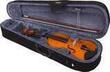
Besides the violin, you need a case, rosin and a correctly tensioned bow; choose separate violin bows according to size and balance. The bridge must stand straight, the pegs must hold their tuning and the strings must not be unnecessarily high. When replacing them, compare the material and tension in the violin strings category.
Acoustic or electric instrument
An acoustic violin resonates through its body without amplification and is standard for tuition. Electric violins make sense for amplification, effects processors or quiet practice with headphones if the model supports such an output. The feel under your hand and the response to the bow may differ, so do not regard them simply as a quieter copy of acoustic violins.
Daily check before storage
After playing, loosen the bow hair and use a soft cloth to remove rosin dust from the strings and varnish. Do not leave the violin near a radiator or in a hot car. A sudden change in humidity can shift the bridge and pegs, so store it in a closed case.
An instrument on its own and a complete set are not the same
A set makes it easier to get started only if the bow matches the size, the case holds the instrument securely and the rosin is not damaged. You do not need to replace inexpensive accessories automatically, but check that they work properly. Your budget should also include the initial setup and a check after the new strings and pegs have settled.
Start tuning with the fine tuners
Four fine tuners help you as a beginner because the large pegs respond more sensitively. Do not force a peg if it sticks or does not hold. If a string breaks, check for a sharp point on the bridge or tailpiece; repeated breakage is not normal wear.
Compare the sound under your ear and in the room
A violin sounds sharper to you as the player than to a listener a few metres in front of the instrument. When trying instruments, play the same short passage on several of them and ask someone to listen from a distance. A louder first impression does not necessarily mean a more even tone across the strings.
Choose the size according to your arm, check the bridge setup and only then consider appearance or accessories.