 Albania
 Argentina
 Australia
 Austria
 Belgium
 Bosnia and Herzegovina
 Brazil
 Bulgaria
 Canada
 Chile
Chile
 Colombia
 Croatia
 Czech Republic
 Denmark
 Estonia
 Finland
 France
 Germany
 Greece
 Hungary
 Ireland
 Italy
Italy
 Latvia
 Lithuania
 Luxembourg
 Mexico
 Moldova
 Montenegro
 Netherlands
 New Zealand
 North Macedonia
 Norway
 Philippines
 Poland
 Portugal
 Romania
 Serbia
 Slovakia
 Slovenia
 South Africa
 Spain
Spain
 Sweden
 Switzerland
 Turkey
 Ukraine
 United Kingdom
 United States of America



Reverbs
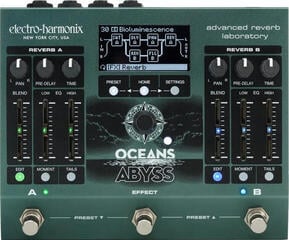
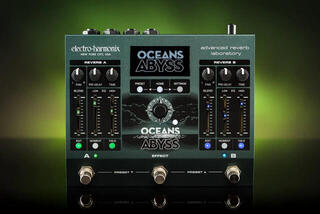
Reverb effects create a sense of space, from the short reflections of a small room through amp-like spring character to long ambient washes. They can make a guitar sound natural, distant or deliberately cinematic. Reverb suits clean rhythm, solos, surf sounds, modern ambient playing and softening a dry practice tone. Choose by reverb types, control range and whether you need one fixed setting or several stored sounds.
Main reverb types
| Type | Sound | Typical use |
|---|---|---|
| Room | Short, natural reflections of a smaller space | Subtle depth without a long tail |
| Hall | Wide space with long, smooth decay | Solos, ballads and fuller clean textures |
| Plate | Dense, bright and even decay | Articulate leads and studio-style clean tone |
| Spring | Metallic, splashy spring character | Surf, blues, rockabilly and vintage amp sounds |
| Shimmer | Decay with upper harmonics or octaves | Ambient layers and cinematic textures |
| Modulated | Decay with gentle motion or detuning | Dream pop, post-rock and wide clean sounds |
A useful pedal does not need dozens of algorithms. Room, hall and plate with a good decay range often cover everyday playing. For a specific spring or shimmer colour, its control and quality matter more than the total number of modes.
Controls you can hear
- Mix, effect level or wet: balances dry and processed signal.
- Decay or time: sets tail length; too much can mask fast notes.
- Pre-delay: separates the original attack from the reverb onset.
- Tone, damping or color: controls brightness and high-frequency decay.
- Modulation: adds movement to the tail.
- Trails: lets decay continue naturally after bypass.
Reverb and delay are different
Reverb blends many reflections into one space, while delay repeats the note at distinct intervals. A short delay thickens guitar without a reverb tail; a long delay creates rhythmic echoes. Set each effect alone, then shorten decay or feedback so layers do not mask each other.
Modulated reverb can resemble chorus, but movement occurs mainly in the decay. For strong modulation of the guitar tone itself, see Chorus, Flanger, Phaser, then add reverb around that sound.
Choosing for your situation
One natural space
For blues, rock, country or clean rhythm, choose simple controls and room, plate or spring. Three knobs can be more practical live than a deep menu. Low mix should add depth without blurring attack.
Ambient and layered music
Long decay, shimmer, modulation, freeze or hold turn reverb into a creative instrument. Expression, two switchable settings and presets are useful. For very wet sounds, check full-wet operation and behaviour when changing algorithms.
Live use with many songs
Presets save time when moving between short room, long hall and shimmer. Two footswitches may control bypass, preset selection or hold. A display helps with many banks but is unnecessary for one or two sounds.
Mono or stereo rig
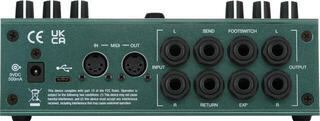
Stereo I/O can widen space between two amps, in a mixer or while recording. For one amp, a strong mono mode matters more. Check how stereo input is summed to mono output.
Where reverb belongs in the chain
Reverb usually comes near the end, after gain and modulation. If amp-preamp distortion is used, the effects loop often gives a cleaner result. Reverb before distortion creates a grainier effect because the whole tail is distorted; useful creatively, but less universal.
Digital reverb may require substantial current. An underspecified supply can cause unstable operation or noise even at the correct voltage. Use suitable power supplies for effects and always follow polarity and electrical requirements. Reverb usually belongs at the end of the board after gain and modulation. If distortion comes from the amp preamp, the effects loop often keeps the decay cleaner. Reverb before distortion creates a rough experimental texture because the entire tail is distorted. For a digital pedal, check required current as well as voltage and polarity.
Simple or programmable reverb?
A simple model suits one reliable space with direct knob control. A programmable pedal makes sense for several bands, song lists with different sounds or synchronisation with other gear. Check preset count, switching and access to important parameters. For natural depth, use a low mix with a short room, plate or spring so attack stays clear. Long decay, shimmer, modulation, freeze and hold suit ambient layers; expression control and presets simplify changes during a song. With delay, set both effects separately first, then shorten decay or feedback so repeats do not mask one another.
Start with the reverb type you use most. Then consider decay, dry-signal clarity and stage control before extra algorithms. The pedal will become a practical part of the rig rather than only a source of impressive demos. On stage, count the sounds you actually switch. For one constant space, three direct knobs are faster than deep menus; for several songs, presets, two footswitches and a display are useful. Stereo I/O widens two amps or recordings, while a mono rig depends more on a good mono mode and correct input summing.