Albania
 Argentina
 Australia
 Austria
 Belgium
 Bosnia and Herzegovina
 Brazil
 Bulgaria
 Canada
 Chile
 Colombia
 Croatia
 Czech Republic
 Denmark
 Estonia
 Finland
 France
 Germany
 Greece
 Hungary
 Ireland
 Italy
 Latvia
 Lithuania
 Luxembourg
 Mexico
 Moldova
 Montenegro
 Netherlands
 New Zealand
 North Macedonia
 Norway
 Philippines
 Poland
 Portugal
 Romania
 Serbia
 Slovakia
 Slovenia
 South Africa
 Spain
 Sweden
 Switzerland
 Turkey
 Ukraine
 United Kingdom
 United States of America



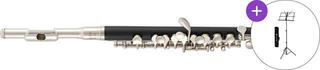
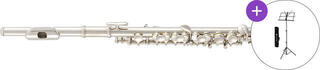
Piccolo Flutes
The piccolo sounds an octave higher than the concert flute and cuts through even dense orchestral textures. A small body does not mean easier playing: the embouchure hole requires a precise airstream and the upper register demands accurate intonation. You should already have solid foundations on the concert flute.
Wood and metal respond differently
A metal or composite body withstands marching and school use better. A wooden piccolo can offer a different tone colour, but it is sensitive to temperature shock and you need to warm it up gradually. Combination models pair a wooden headjoint with a more durable body.
The mechanism must seal with minimal pressure
Small keys respond to slight deformation. Try a quiet attack in the lower register and a smooth transition across the octave. Blowing harder will not fix a leak; it will only raise the pitch and increase fatigue.
A piccolo does not replace a standard flute
The technique is related, but the repertoire and role are different. You can find standard models among concert flutes. The recorder uses a completely different method of producing sound.
Protect your hearing while playing too
The high register is produced close to your ear and can be very loud in a rehearsal room. Sensible breaks and musicians' earplugs are worthwhile during long rehearsals. Always swab the instrument after playing and leave it to dry.
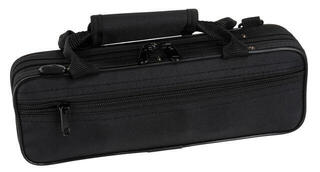
The case must not press on the keys
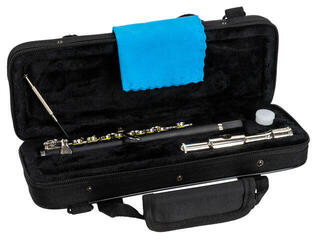
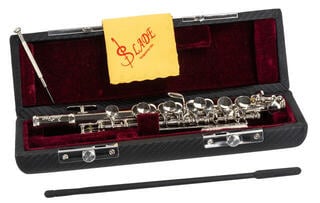
Place the piccolo in a precisely moulded compartment and separate the headjoint from the body without twisting the mechanism. Choose a swab for the narrow bore so that it does not become stuck inside the body.
Choose a piccolo according to the seal of its mechanism, its material and the security of your embouchure; do not let the instrument's size mislead you about how demanding it is.