Albania
 Argentina
 Australia
 Austria
 Belgium
 Bosnia and Herzegovina
 Brazil
 Bulgaria
 Canada
 Chile
 Colombia
 Croatia
 Czech Republic
 Denmark
 Estonia
 Finland
 France
 Germany
 Greece
 Hungary
 Ireland
 Italy
 Latvia
 Lithuania
 Luxembourg
 Mexico
 Moldova
 Montenegro
 Netherlands
 New Zealand
 North Macedonia
 Norway
 Philippines
 Poland
 Portugal
 Romania
 Serbia
 Slovakia
 Slovenia
 South Africa
 Spain
 Sweden
 Switzerland
 Turkey
 Ukraine
 United Kingdom
 United States of America



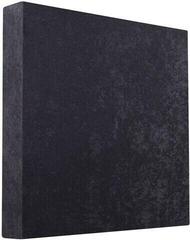
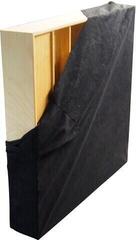
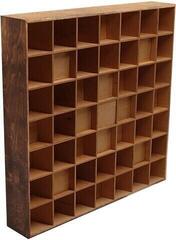
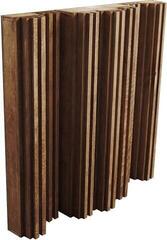
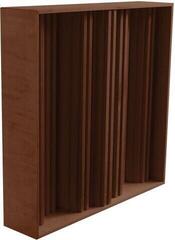
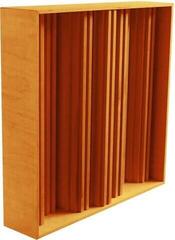
Diffusors
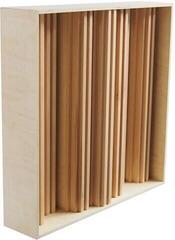
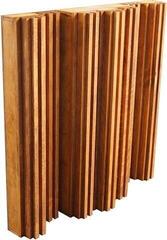
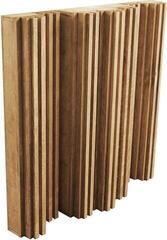
An acoustic diffuser scatters reflected sound in several directions so that the energy does not return to the room as one pronounced reflection. In a studio, listening room, or rehearsal room, it can help retain a livelier character without unpleasant flutter echo. However, it is not a universal substitute for absorption or a device that will solve every acoustic problem on its own. First identify the audible problem, find the surface the reflection comes from, and measure the distance to the listening position.
What diffusion changes
A flat, hard surface reflects a large part of sound in an orderly way. When direct sound meets such a reflection after a short delay, the clarity of a recording and the precision of the stereo image can suffer. A diffuser uses a shaped or deeply segmented surface that distributes the reflection in space and time. The result depends on the element's geometry, frequency, position, and room dimensions.
An absorption panel works differently: it converts part of the sound energy and reduces the strength of the reflection. A diffuser predominantly redirects it. This is why both elements are often used in the same room. Their proportion cannot be calculated from wall area alone, though. A small room with a short listening distance may need a different solution than a larger control room, where scattered sound has space to decay.
| Element | Main role | When to consider it | Limitation |
|---|---|---|---|
| Diffuser | Scattering a reflection in several directions | When you want to reduce a noticeable reflection while keeping the room lively | It needs a suitable distance and works only within a certain frequency range |
| Absorption panel | Reducing reflection energy | Early reflections near speakers, vocals, or the work position | Too much thin absorption can dampen high frequencies while leaving a bass problem |
| Bass trap | Treating low frequencies | Corners and places with uneven bass | It requires space and a suitable construction |
Where to place a diffuser
In a listening room, diffusion is often considered for the rear wall, behind the listener, but this rule has exceptions. If you sit close to the wall, the scattered reflection may not have enough path length to combine with the direct sound in a useful way. In that case, absorption or moving the desk may be more suitable. Side-wall early reflections are addressed according to the room's purpose and the result of a measurement or listening test.
Try first, then buy
- First position the speakers and listening position symmetrically and away from obviously unsuitable points in the room.
- Listen to speech, familiar recordings, and a short impulse, such as a hand clap. Note specific effects, not just an impression of “bad acoustics”.
- Find early reflections from the side walls and ceiling. The mirror method can help, but measurement gives a more accurate picture.
- Temporarily try changing the position or adding absorption, then compare the result. Buy a diffuser only once you know which surface and frequency range it should address.
Dimensions, depth, and operating range
Surface segmentation is not merely decoration. The depth and width of individual sections affect the frequencies at which sound starts to scatter effectively. A shallow, fine profile will not solve deep bass; a large, deep element, on the other hand, takes up more space and may be unsuitable in a narrow room. Look for the manufacturer's information on the recommended distance and effective range, if provided.
The size of the covered area also matters. One small element in the middle of a large bare wall may have only a limited effect, but without measurement it makes no sense to automatically cover the entire room. Take doors, windows, furniture, secure mounting, and weight into account. For ceiling installation, use an anchoring method intended for the given substrate.
Studio, rehearsal room, and listening room
When mixing, you need a stable stereo image and predictable response. Diffusion can reduce the disruptive character of later reflections, but first address the position of the studio monitors, the listening position, and early reflections. When recording an acoustic instrument or vocals, a scattered sound field can contribute to a more natural reverberation. However, the microphone also captures shortcomings, so always fine-tune its position with a test recording.
In a rehearsal room, the goal is often better clarity between loud instruments. A diffuser alone will not solve excessive volume or low-frequency resonances. Sensible amplifier orientation, volume control, absorption in suitable places, and, where needed, elements designed for bass will help. You can compare absorption, bass traps, and other solutions among studio acoustic elements.
Material and installation
- Wooden and solid profiled elements tend to be heavier; check the wall's load-bearing capacity and mounting method.
- Lightweight shaped elements are easier to install, but their effect is not determined by material or appearance alone. Geometry and the stated intended use are decisive.
- Combination panels combine scattering with absorption. Assess them by the information on both functions, not by their name.
- Modular assemblies allow the coverage to be expanded, but the intended alternation or orientation of the parts must be followed.
Measure your space before ordering
Note the width, height, and obstacles on the planned surface, the distance to the listener, and the wall type. Check the weight, dimensions, mounting system, and recommended acoustic use of the specific product. If the room is troubled mainly by boomy bass, look instead at bass traps and speaker positioning. Choose a diffuser only for a specific reflection and a place where scattered sound has enough space.