Albania
 Argentina
 Australia
 Austria
 Belgium
 Bosnia and Herzegovina
 Brazil
 Bulgaria
 Canada
 Chile
 Colombia
 Croatia
 Czech Republic
 Denmark
 Estonia
 Finland
 France
 Germany
 Greece
 Hungary
 Ireland
 Italy
 Latvia
 Lithuania
 Luxembourg
 Mexico
 Moldova
 Montenegro
 Netherlands
 New Zealand
 North Macedonia
 Norway
 Philippines
 Poland
 Portugal
 Romania
 Serbia
 Slovakia
 Slovenia
 South Africa
 Spain
 Sweden
 Switzerland
 Turkey
 Ukraine
 United Kingdom
 United States of America



Ceiling Speakers
A ceiling speaker is installed into a suspended ceiling, so the grille is primarily what remains visible in the room and the sound can cover the area from above. It is used for background music and announcements in shops, offices, restaurants, schools and homes. The type of distribution system, cut-out diameter, mounting depth, room characteristics and number of positions determine the choice. Before making the first cut, check the ceiling construction and whether the speakers match the amplifier.
Choose the connection system first
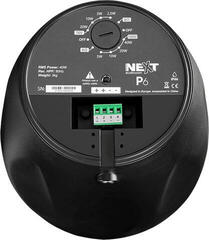
Low-impedance wiring is used mainly for a smaller number of speakers and shorter cable runs, for example in a home stereo system. The impedance of the entire branch must remain within the range supported by the amplifier. The resulting value changes with series and parallel connections, so do not add speakers by estimation.
A constant-voltage distribution system, commonly called 100 V, is practical for a larger number of speakers and longer cable runs in a building. Each speaker has a transformer and selectable power tap; the total of the selected taps must leave headroom for the amplifier according to the system design. Connect such a speaker to a suitable 100 V amplifier, not to a standard home output without checking.
| Solution | Typical use | Advantage | Check before installation |
|---|---|---|---|
| Low impedance | Home zone, smaller room, stereo | A straightforward route to music listening in a small system | Total impedance, conductor cross-section and cable length |
| 100 V distribution | Multiple rooms, commercial premises, announcements | Easier branching for a larger number of positions | Total power taps, suitable amplifier and transformer settings |
| Active solution | Standalone zone according to the specific system | Amplification is part of the system | Power supply, control and data or audio cabling |
The cut-out is not the outer diameter
A product has an outer grille dimension, a required cut-out diameter and a mounting depth. Do not confuse these three measurements. There must be room above the suspended ceiling for the speaker body, cable, connector and secure fixing. With plasterboard, check profiles, electrical wiring, pipework and lights; a finished opening is harder to relocate than a mark on a plan.
Some spaces require a back cover, fire hood or other protection according to the project and local regulations. In a bathroom, kitchen or covered outdoor area, address resistance to moisture and environmental conditions according to the manufacturer’s information. A decorative grille alone does not confirm suitability for demanding conditions.
How many speakers and where
Several suitably spaced speakers will usually cover a room more evenly than one loud point source. However, the required number depends on the dispersion angle, ceiling height, floor plan, desired volume and layout of the space. Use the manufacturer’s data to plan overlap between listening areas. In a restaurant, consider tables and zones; in an office, workstations; and in a corridor, its long narrow shape.
Stereo or even mono
In a living room with a fixed listening position, left and right channels make sense. In a large commercial space, the listener often moves around or stands under a single speaker, so consistent mono may be more practical. There are also speakers that accept both channels at one mounting point; check their connection and purpose in the documentation. Never connect amplifier outputs directly together.
One-way or multi-way
A one-way speaker uses one driver or a shared solution for most of the audible frequency range. A two-way design adds a separate tweeter and can reproduce high frequencies more clearly, but the result is not determined by the number of ways alone. Construction, placement, signal processing and room acoustics are important. For announcements, you will assess intelligibility above all; for music, also balance across the entire zone.
If you need fuller bass, ceiling models can be supplemented with a subwoofer depending on the system. Its position and crossover frequency need to be set so that it does not draw attention to itself. Simply adding a bass speaker will not solve overloaded ceiling drivers or an inappropriately set volume.
Installation and cabling
- Prepare a plan of zones, cable runs and mounting points. Check each position with a detector and by visually inspecting the space above the ceiling.
- Use cable suitable for the particular installation and building conditions. Label the run at both ends.
- Before closing up or making the final fixing, check continuity, polarity and power-tap setting.
- Secure the speakers evenly according to the instructions, without overtightening the mounting clamps.
- Start the system at low volume and test every zone, then set balanced levels.
For public-address systems, emergency announcements or a building with special fire-safety requirements, the design belongs in the hands of a qualified professional. An ordinary music installation and a certified voice evacuation system are not the same thing.
When the ceiling is unsuitable
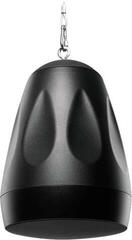
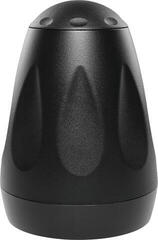
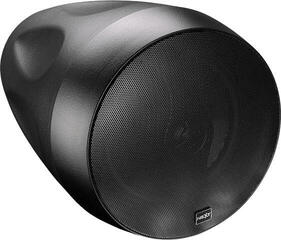
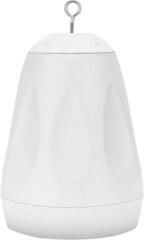
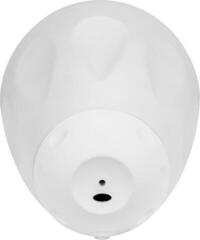
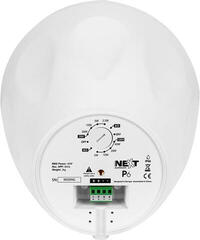
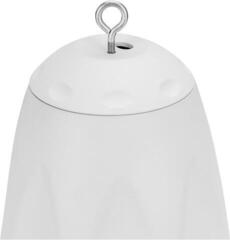
A concrete ceiling, a very small void or the need to change the direction of sound can complicate installation. In that case, consider outdoor speakers for a suitable outdoor environment or surface-mount speaker cabinets according to the placement. The original description mentioned AUDAC, Magnat, FBT and NEXT Audiocom. However, a brand does not replace checking the dimensions, connection and intended use of a specific product.
Checklist before cutting openings
- amplifier and distribution-system type, number of zones and method of volume control;
- cut-out, outer diameter, mounting depth and load-bearing capacity of the substrate;
- number of speakers based on coverage, not just floor area;
- suitability for moisture, dust or outdoor conditions;
- cable route, polarity, service access and compliance with the building design.
If recessed installation is not feasible, compare surface-mount solutions according to the specific room and installation method. The completed installation should retain even volume, safely concealed cabling and access for servicing.